Hospice and Palliative Medicine Fellowship
Clinical Rotations
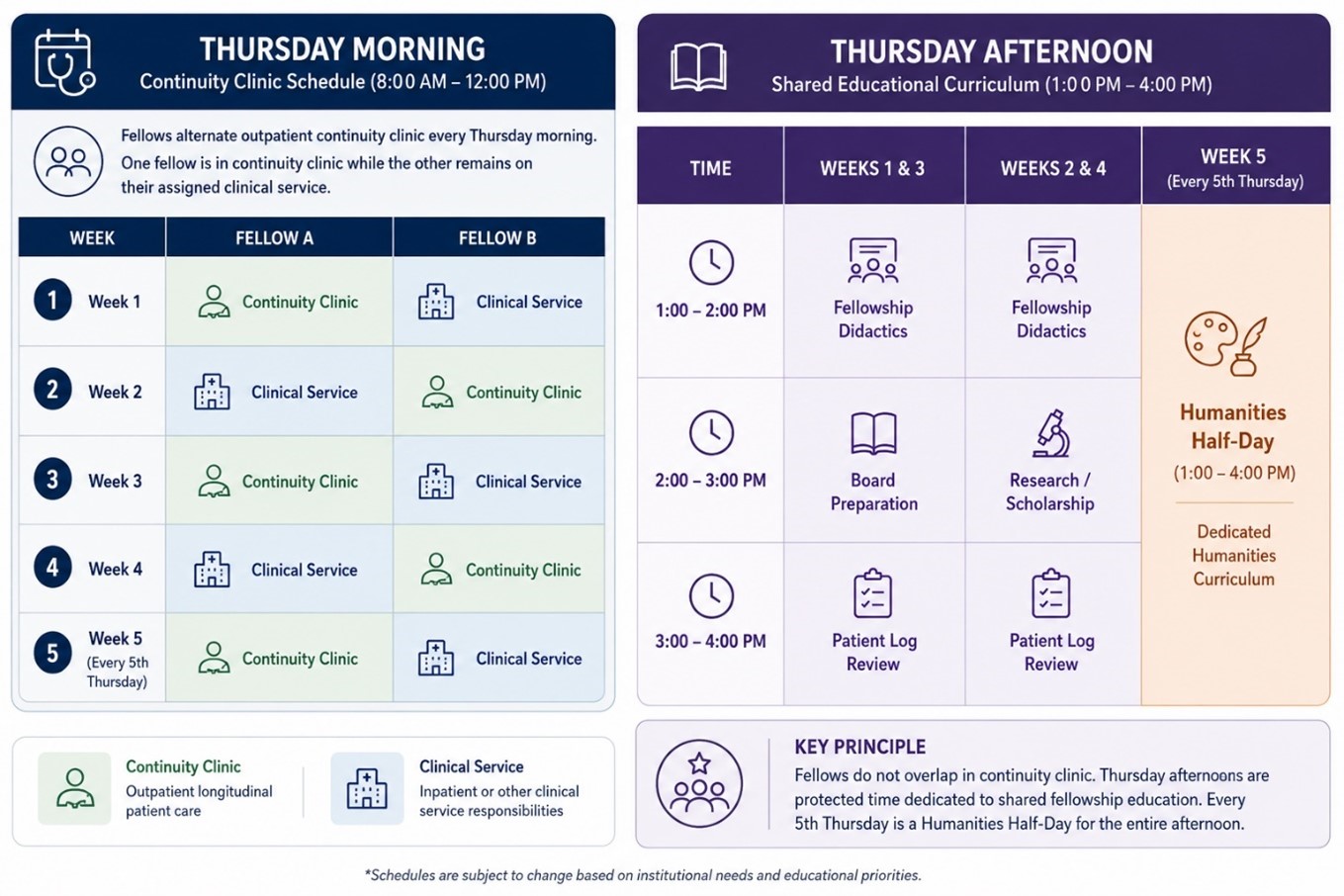
Our fellowship is designed to provide a balanced experience across inpatient palliative care, hospice, outpatient practice, research, oncology, addiction medicine, pediatric palliative care, and individualized electives. Fellows rotate through a variety of clinical settings while maintaining continuity with a longitudinal outpatient patient panel throughout the year. This structure ensures comprehensive exposure to the full spectrum of hospice and palliative medicine while allowing flexibility to pursue individual educational interests. Of note, the outpatient continuity clinic will be on Thursday mornings, with fellows rotating on an every-other-week basis. One fellow will be excused from their service duties to attend clinic while the other remains on their respective service, then switch the following week. Thursday afternoons are academic protected time. See the Curriculum page for more details.
| Rotation | Approximate Time |
|---|---|
| Bootcamp | First 4 weeks |
| Inpatient Palliative Care | Six 4-week blocks, every other rotation |
| Hospice | Three 4-week blocks |
| Research / Outpatient Clinic | Two 2-week blocks |
| Inpatient Addiction medicine | 2 weeks |
| Outpatient Oncology | 2 weeks |
| Pediatric Palliative Care | 2 weeks |
| Elective | 2 weeks |
| Continuity Clinic | Every other Thursday Morning |

Bootcamp
The first 4 weeks of your fellowship experience will be dedicated to building on your foundation of palliative care principles. There will be both classroom learning as well as clinical experiences.
- Core communication and goals-of-care skills
- Comprehensive symptom management
- Roles of interdisciplinary team members
- Professional development and system-based practice
- Inpatient and outpatient exposure and application
This rotation will prepare you to confidently handle the rigors of fellowship.
Inpatient Palliative Care Service
The inpatient palliative care service occurs approximately every other month throughout the academic year and serves as the cornerstone of the fellowship experience.
During this rotation, fellows work closely with interdisciplinary teams to provide:
- Intensive symptom management
- Goals-of-care discussions
- Advance care planning
- Complex decision-making support
- Coordination of care across multiple specialties and services
Call Responsibilities
- Overnight call is taken Monday through Thursday while assigned to the inpatient service. This call is taken from home at the end of the work day.
- No overnight call is required on Fridays, Saturdays, or Sundays.
- Fellows on the inpatient service round on the 1st and 3rd Saturdays of each block.
- Fellows who are not assigned to the inpatient service do not participate in inpatient call or weekend rounding.
- Equitable holiday coverage will be assigned based on faculty coverage (average of 3-4 days per year)
Hospice Service
Fellows spend dedicated time with Iowa City Hospice under the supervision of board-certified hospice physicians.
This rotation provides immersive exposure to community-based serious illness care through:
- Management of a personal panel of hospice patients
- Home visits and facility-based care
- Symptom management in the community setting
- Participation in weekly interdisciplinary team (IDT) meetings
- Exposure to respite and General Inpatient (GIP) hospice care within hospital settings
- Administrative duties related to the role of a hospice medical director
The hospice experience emphasizes longitudinal patient relationships and the unique challenges of caring for patients and families across the end-of-life continuum.
Inpatient Addiction Medicine Rotation
Working with inpatient addiction medicine specialists allows fellows to:
- Recognize, evaluate, and manage opioid use disorder
- Broaden an understanding of substance use disorders
- Develop skills in complex pain management
- Navigate the intersection of addiction and serious illness care
Outpatient Oncology
Working with excellent outpatient oncologist, fellows will gain a deeper understanding of:
- Cancer-directed therapies with related symptoms
- Oncology treatment planning
- Prognostic appreciation
- Collaboration between oncology and palliative medicine teams
Pediatric Palliative Care & Elective Time
Pediatric Palliative Care
Fellows complete a two-week pediatric experience designed to build a foundation in caring for children with serious illness.
The rotation focuses on:
- Developmental considerations in communication
- Pediatric symptom management
- Family-centered care
- Key differences between adult and pediatric palliative medicine
Elective Rotation
An additional two weeks of elective time allows fellows to tailor the fellowship to their interests.
Potential elective experiences may include:
- Geriatrics
- Intensive care
- Neurology
- Psychiatry
- Oncology
- Pediatrics
- Hospice
- Addiction Medicine
- ALS Clinic
- Outpatient Palliative care
- Inpatient Veterans Association
- Research
- Other approved specialty experiences