Hospice and Palliative Medicine Fellowship
Research and Scholarship
Whether your goal is academic medicine or community practice, our fellows receive dedicated time, mentorship, and institutional support to develop scholarly projects that improve patient care and advance their careers.
While research is an important component of professional development, we recognize that it may not be everyone’s primary interest—especially for those returning to training from clinical practice. The University of Iowa is uniquely structured to help every fellow succeed in this arena. We provide robust physician faculty mentorship, dedicated statisticians to assist with project design and data analysis, and access to a nationally acclaimed writing center to support abstract and manuscript production.
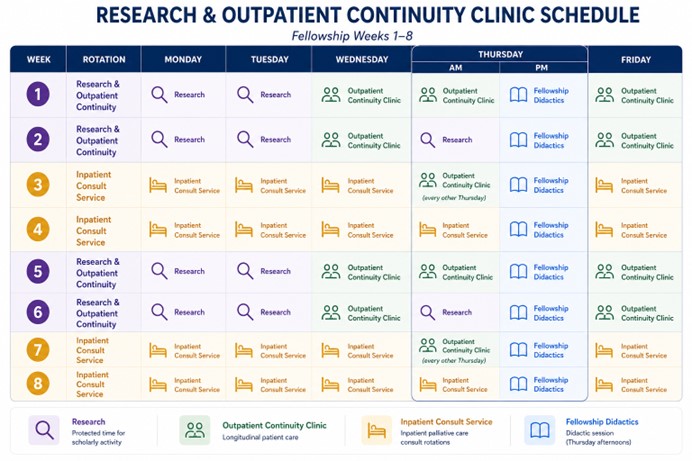
To support early scholarly development and foster longitudinal patient relationships, fellows begin the academic year with a dedicated Research and Outpatient Continuity Rotation. This rotation is structured as two separate two-week blocks, interspersed with inpatient service, allowing fellows to gradually acclimate to their new clinical responsibilities while establishing two foundational components of fellowship training: a meaningful research project and a continuity clinic panel.
During this rotation, Monday and Tuesday are dedicated to scholarly activity, providing protected time to develop a research question, identify mentors, conduct literature review, and build a project suitable for submission to the AAHPM Annual Assembly and other academic venues.
Wednesday and Friday are devoted to outpatient continuity clinic, where fellows begin building and following their own panel of patients throughout the year. This longitudinal experience promotes continuity of care, strengthens outpatient palliative medicine skills, and allows fellows to follow patients across different stages of illness.
Thursday mornings alternate between additional continuity clinic and protected research time. Thursday afternoons are reserved for the fellowship's didactic curriculum and educational conferences.
This structure allows fellows to establish a strong academic and outpatient foundation early in the fellowship while gradually transitioning into the demands of inpatient palliative care practice.